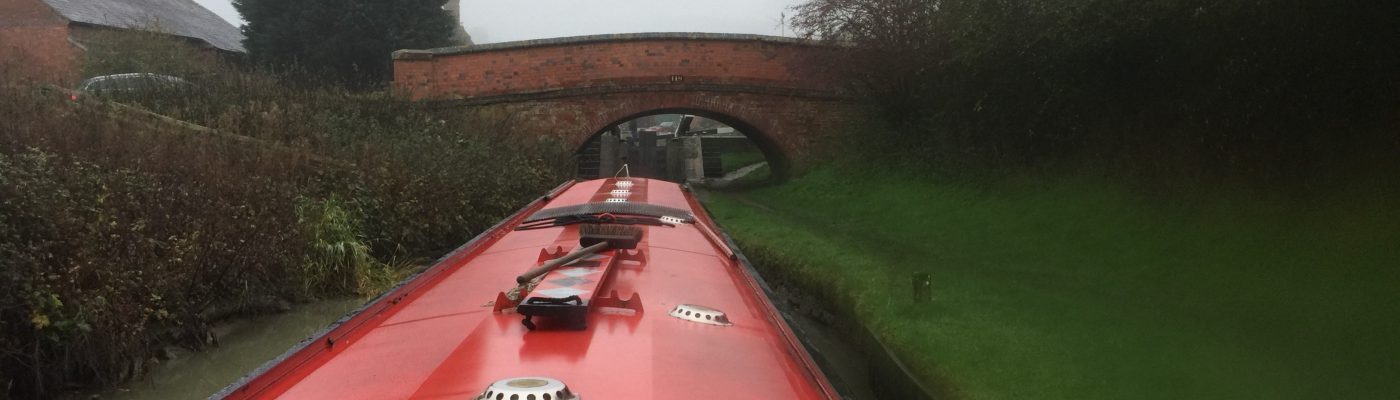
Idiot Wind, the first novel by new author Mike Broihier, follows the journey of ‘Mac’ McGuire on England’s Oxford Canal. McGuire, a veteran of the wars in Iraq and Afghanistan, has scored the job of a lifetime. He delivers food and fuel to customers on a weeklong route that takes him through some of the most beautiful and tranquil countryside in England. All is well until bodies start popping in the canal and fingers start pointing toward him.
Read a chapter of Idiot Wind
“Idiot Wind was a traditional narrowboat, or “Trad” to those in the know. The foredeck was an open space, just over two meters long. When I got back to the marina, there were bottles of propane and a stack of bagged coal and stove pellets alongside waiting to be loaded. I took advantage of the clear foredeck, and moved my contraband inside through the forward hatch, stowing the cream and butter in the propane fridge and shoving the non-perishables into my unused stateroom.

I preferred to sleep in the boatman’s cabin at the back of the boat. Though further from the stove, it was nearer the aft hatch and home to all the boat’s controls.
I lit off my small coal burner, a Morso Squirrel stove, in anticipation of a chilly night, then turned to loading my legitimate cargo. By the time I had stowed the propane under the foredeck seats and finished stacking the stove fuel, full dusk had fallen, and I could see my breath.
I rolled a smoke and sat on the steel bulkhead, enjoying the stillness of the evening. There was no traffic on the highroad, no murmuring of guests and even the pair of mallards sliding by with the current were silent. A crunch of gravel started me from a doze.
“Mum has made a nice curry and would like it if you’d join us for supper,” said Jack without warning.
How a man of Jack’s thickness moved so silently was a wonder. From his close-cropped steel-wool hair to his steel-toed work boots, he was an imposing figure. Despite his thick neck and chest, and thick arms and legs, straining his spotless Laidlaw’s Marina work shirt and khakis, he moved with stunning grace.
I was less surprised by his silent manifestation within a knife stroke of my back than his offer.
One reason I was still alive was an ability to spot anomalies, groomed into me by one of my platoon sergeants. He would ask us squad leaders questions like, “Where are all the women and children?” “Why is that car parked there?” “Why is no one at the mosque today?” “Where did that kid get a cellphone and who is he talking to?”
Our smart-ass reply was usually, “The fuck if I know,” but we had kicked our point men in the ass, checked our six and made sure no one was daydreaming.
The ability to notice when something is missing, or something has been moved, or something has been added, or something is present that does not belong can be taught. In modern combat, the ability to spot anomalies is often the difference between returning home mostly whole, in pieces, or in a bag.
Jack Laidlaw’s second invitation to dinner was an anomaly and I took notice.
“That would be nice, Jack. What time?”
“Half hour. Wash your hands and change your clothes, you’re a mess,” Jack said as he turned and walked up the gravel path to his house as silently as he’d descended.
I pitched my smoke in the canal and climbed onto my boat. The butt sizzled briefly and began its journey down the canal towards the Thames and, from there, to the sea, eventually.
Idiot Wind’s previous owners had also lived aboard and fitted the boat with two items I found indispensable: a high efficiency washer/dryer combination in the boatman’s cabin and a propane-fired tankless water heater in the head.
The German-designed laundry was a wonder of technology; it used barely any energy, water or soap but made quick work of the few changes of clothes that comprised my wardrobe. I chucked my coal-dusted jeans and sweater in and started the device to its wizardry. Three short steps forward brought me to the head and a quick glance in the mirror confirmed Jack’s assessment; I looked like shit.
For ten minutes I blasted myself clean with obscene amounts of hot water, then shaved. Between the shower and the laundry, I’d have to pump out my black water tank and top up the fresh water before getting underway tomorrow, but that was free, a fringe benefit of working at a marina.
After donning what I thought of as my “good jeans” and an unstained sweater, I lifted one of the bench seats of my dinette and selected two bottles of Bordeaux.
This wasn’t the Tesco crap I peddled to customers, but some fine wine I got from a buddy who lived in Germany. I slept on his couch for a few days while passing through Bavaria, and he stocked me up when I moved on. His sister owned a vineyard in France, and my friend’s apartment had cases of wine stacked floor to ceiling. He told me to save the Bordeaux for special occasions and I felt my impending diner en famille with the Laidlaws was about as exciting as my life was bound to get.
The Laidlaws’ house stood between complimentary parts of their business. The boatyard lay on the downstream side, toward Oxford. On the upstream side, toward Banbury proper, was the marina, a small but neat set of H-style floating docks that currently were permanent moorings for eight narrowboats.
The docks were well lit but didn’t offer water or shore power hook-ups, which discouraged people from living in the marina. Its only permanent resident was Phillip Stewart, Jack’s yardman and factotum.
Phillip served with Jack in the Commandos, and always saw me as an intruder, begrudging my hiring. Lank-haired and perpetually greasy, Phillip was an odd contrast to the shipshape nature that defined Laidlaw’s Marina. Coal smoke came from the chimney of Phillip’s boat, and I heard the subdued sound of a football match as I walked past, strangely relieved he wasn’t joining us for dinner.
As I ascended to the house, the boatyard was to my left. There was one covered slip for in-water repairs and another where boats up to 70-feet could be hauled out for major repairs, anode replacement and hull blacking. Idiot Wind was out of the water getting hull maintenance when I bought her and that is how I’d met Jack. The previous owner ran out of cash to pay for the repairs and Jack was selling it for him to recoup the work he had already done.
For some reason, and to Phillip’s chagrin, Jack had taken a liking to me and brokered an exceptionally good deal on the boat. In fact, he offered to let me live aboard in exchange for helping with the maintenance and general work around the boatyard and marina. Money wasn’t a big issue for me, but the chance to learn the ins and outs of my new home while it was out of the water was a great opportunity.
I chipped, sanded and blacked the hull under Phillip ’s grudging tutelage and helped him pull and repack the driveshaft and gearbox. By the time we refloated her, I felt I knew enough about the arcane electric, hydraulic, and mechanical systems found on narrowboats to stay out of trouble. I also had a new job that would lead to fun, profit and, ultimately, danger.”
 McGuire Mysteries